Learn across scenes
Learn scene priors from posed RGB images.
IEEE Transactions on Geoscience and Remote Sensing2022
School of Astronautics, Beihang University
* Corresponding author
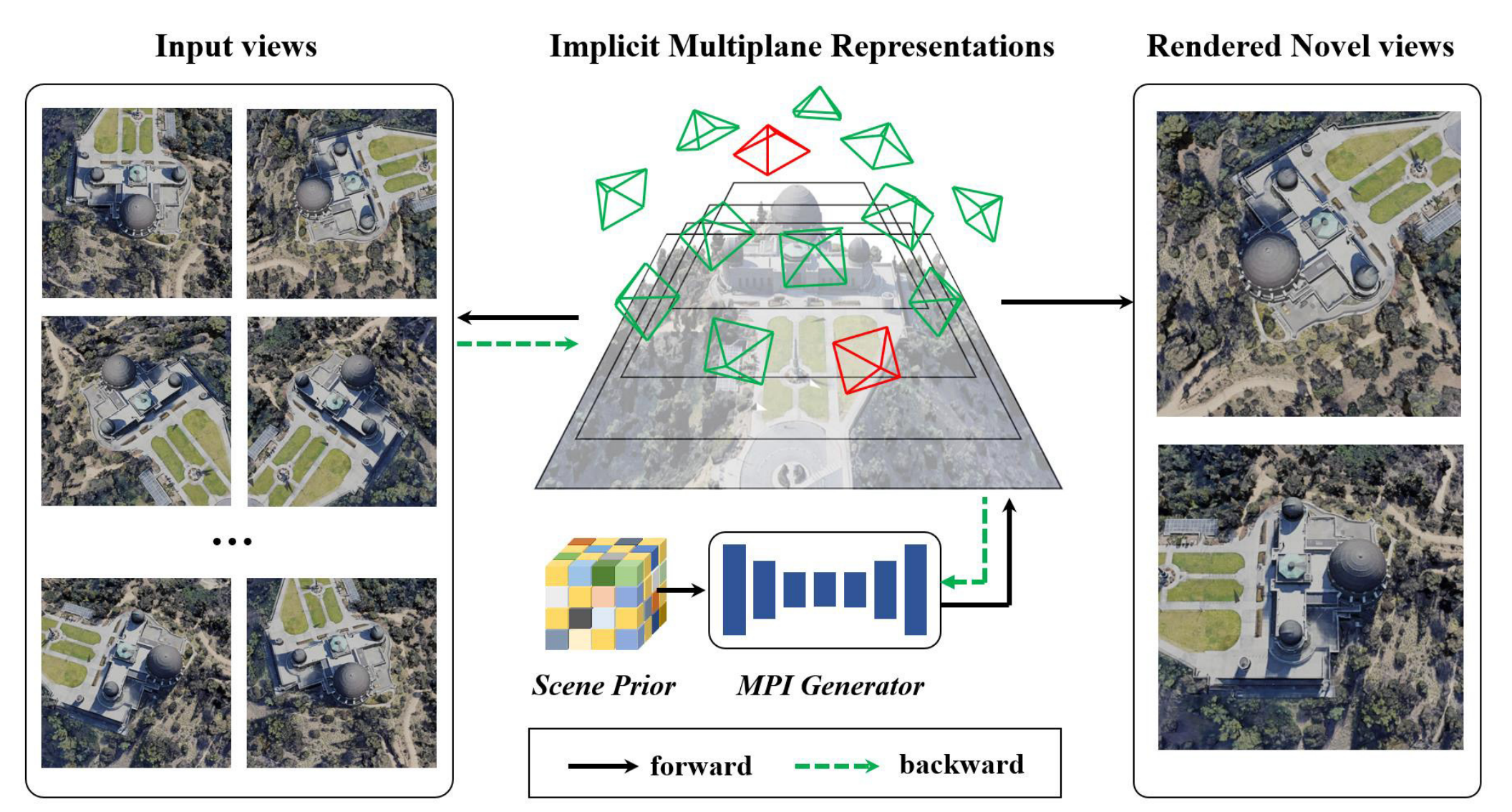
ImMPI combines learned scene priors and implicit multiplane representations to reconstruct remote sensing scenes from sparse posed images and synthesize novel views through differentiable rendering.
Novel view synthesis of remote sensing (RS) scenes is of great significance for scene visualization, human–computer interaction, and various downstream applications. Despite the recent advances in computer graphics and photogrammetry technology, generating novel views is still challenging particularly for RS images due to its high complexity, view sparsity, and limited view-perspective variations. In this article, we propose a novel RS view synthesis method by leveraging the recent advances in implicit neural representations. Considering the overhead and far depth imaging of RS images, we represent the 3-D space by combining implicit multiplane images (ImMPI) representation and deep neural networks. The 3-D scene is reconstructed under a self-supervised optimization paradigm through a differentiable multiplane renderer with multiview input constraints. Images from any novel views thus can be freely rendered on the basis of the reconstructed model. As a by-product, the depth maps corresponding to the given viewpoint can be generated along with the rendering output. We refer to our method as ImMPIs. To further improve the view synthesis under sparse-view inputs, we explore the learning-based initialization of RS 3-D scenes and proposed a neural-network-based prior extractor to accelerate the optimization process. In addition, we propose a new dataset for RS novel view synthesis with multiview real-world Google Earth images. Extensive experiments demonstrate the superiority of the ImMPI over previous state-of-the-art methods in terms of reconstruction accuracy, visual fidelity, and time efficiency. Ablation experiments also suggest the effectiveness of our methodology design.
ImMPI learns scene priors, refines each scene’s implicit representation, and renders novel views from explicit planes.
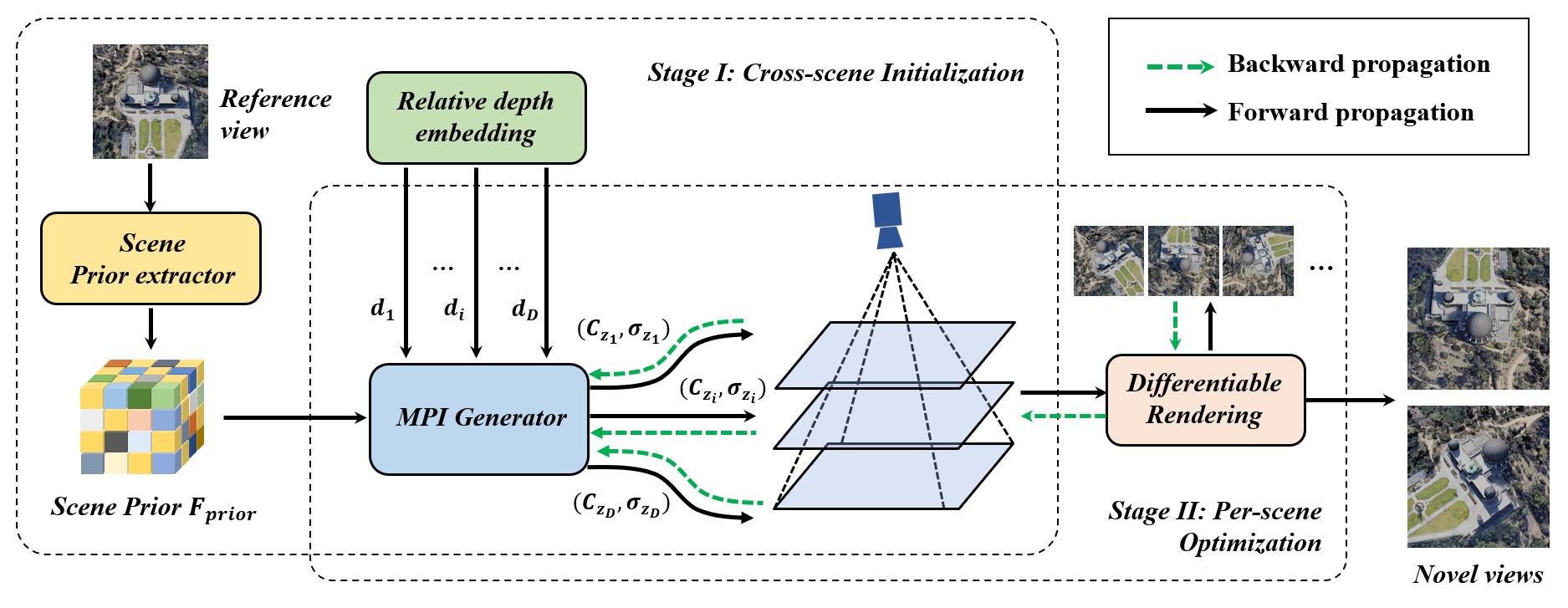
Learn scene priors from posed RGB images.
Refine the MPI generator using the scene’s input views.
Warp and composite planes to render novel views and depth.
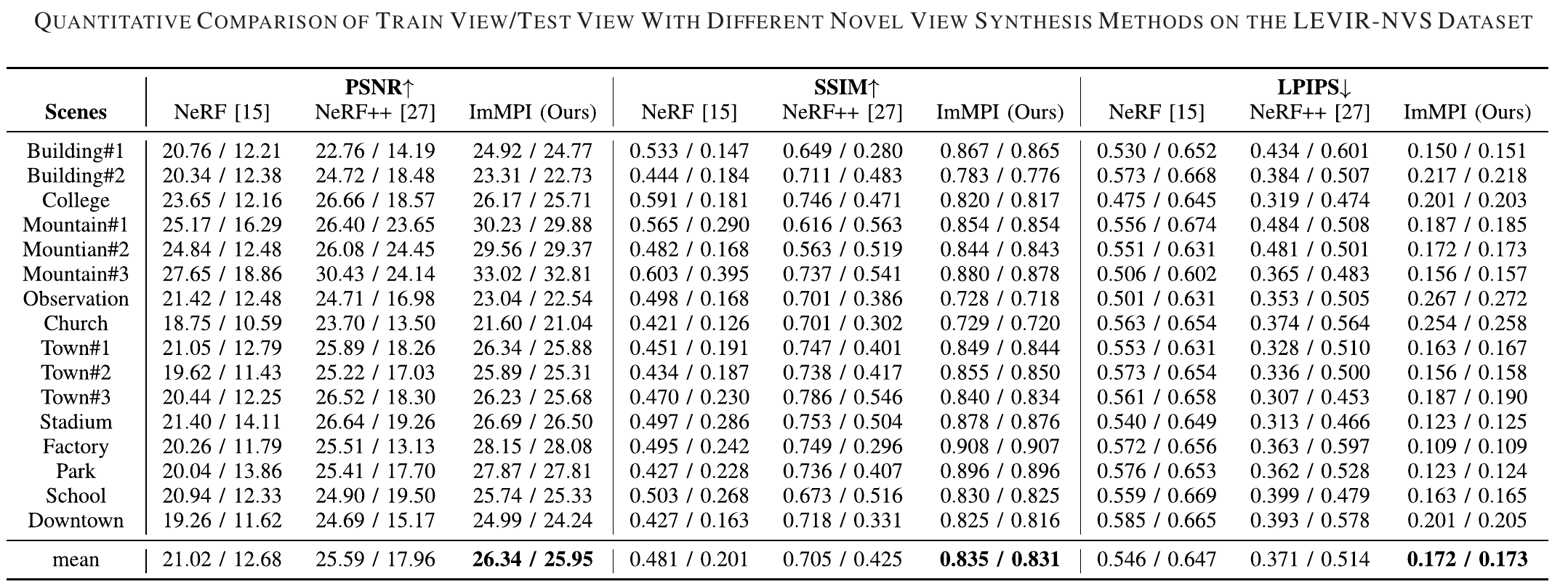
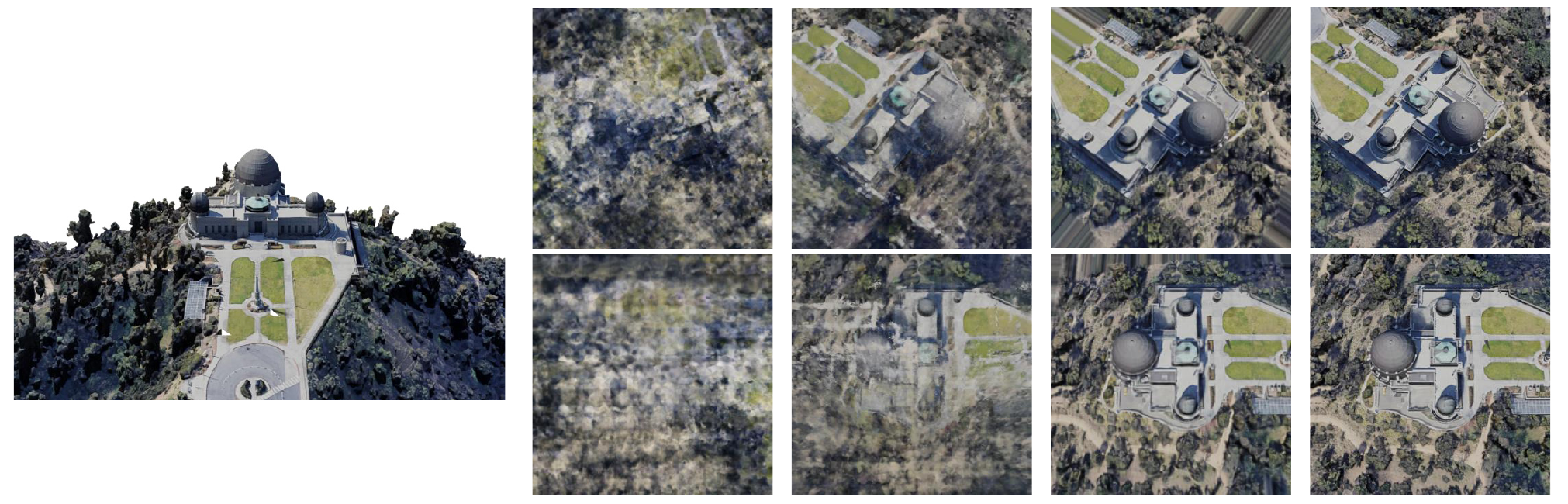
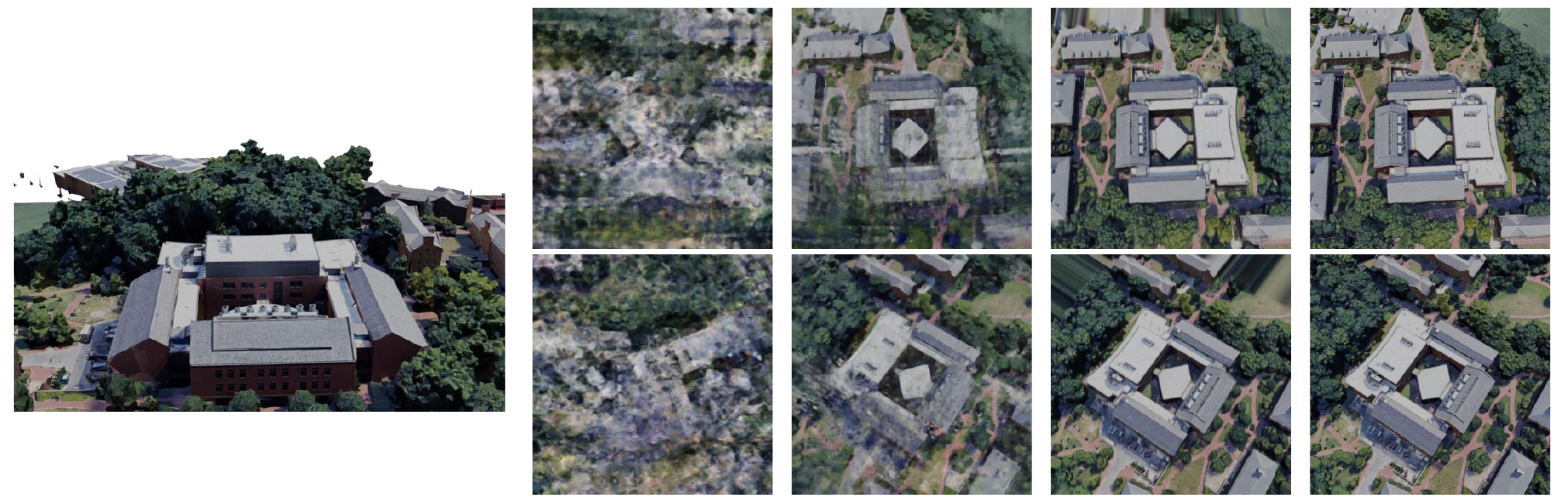
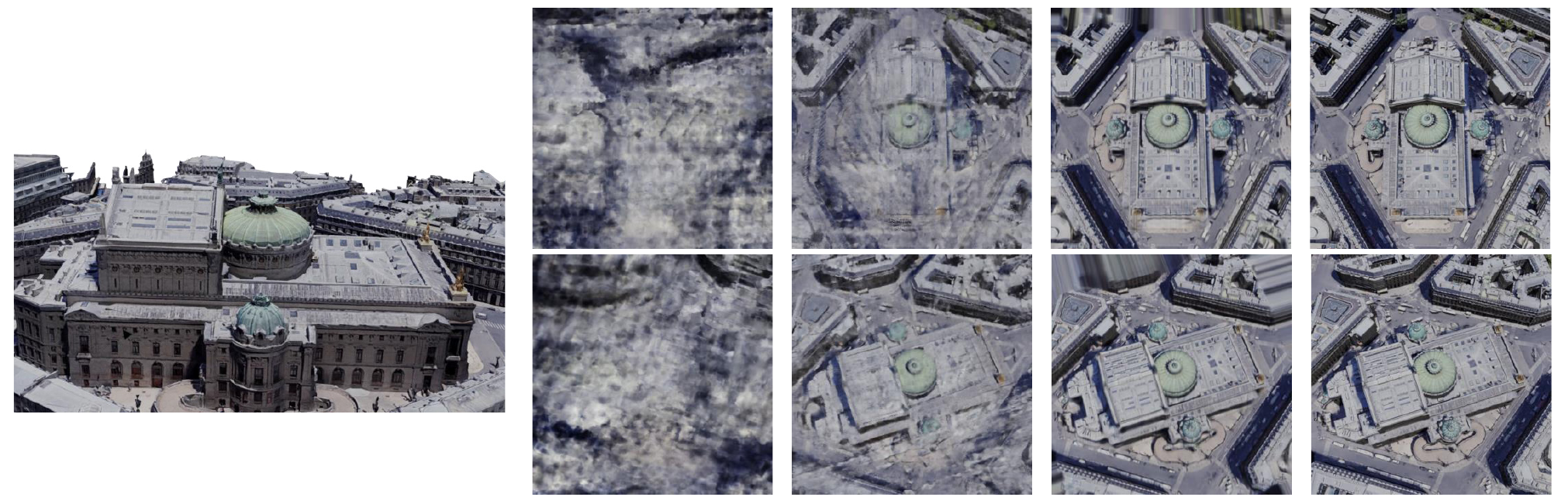
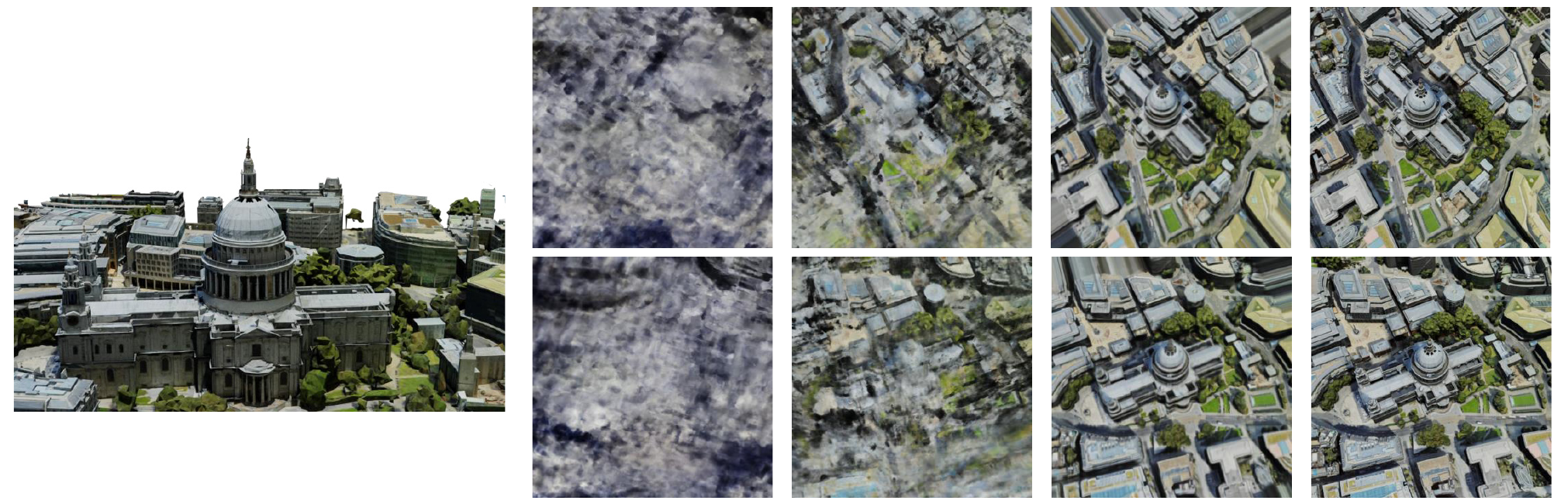
ImMPI achieves higher average image quality and sharper novel-view renderings than NeRF and NeRF++ on held-out LEVIR-NVS viewpoints.
Different depth planes capture different parts of the scene, from rooftops to the ground. Explore the color and sigma values produced by the optimized representation.
These visualizations illustrate the representation; they are not depth-accuracy measurements.
Observation · Sigma values separate scene content across depth planes.
Observation · RGB values of the explicit MPI layers, alongside the rendered image and depth.
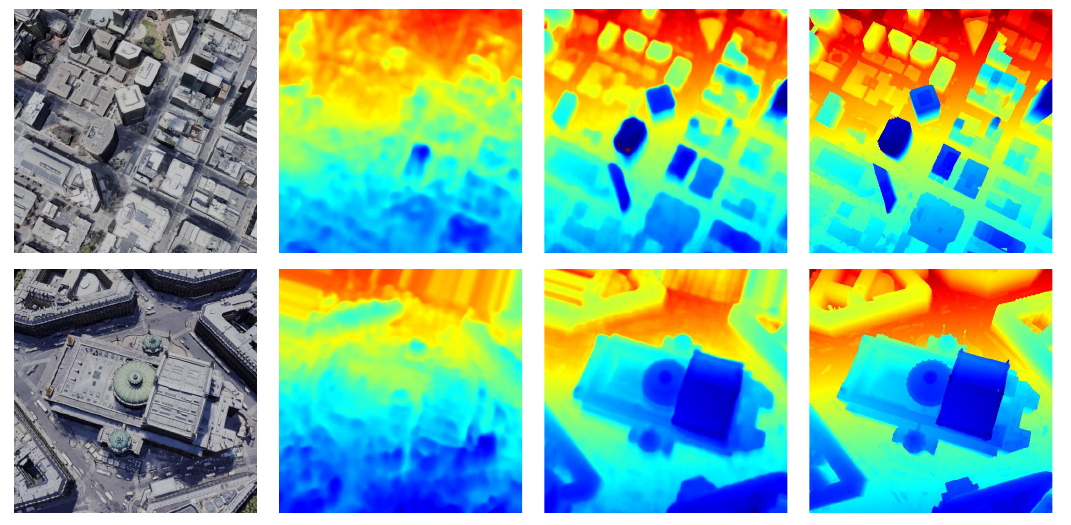
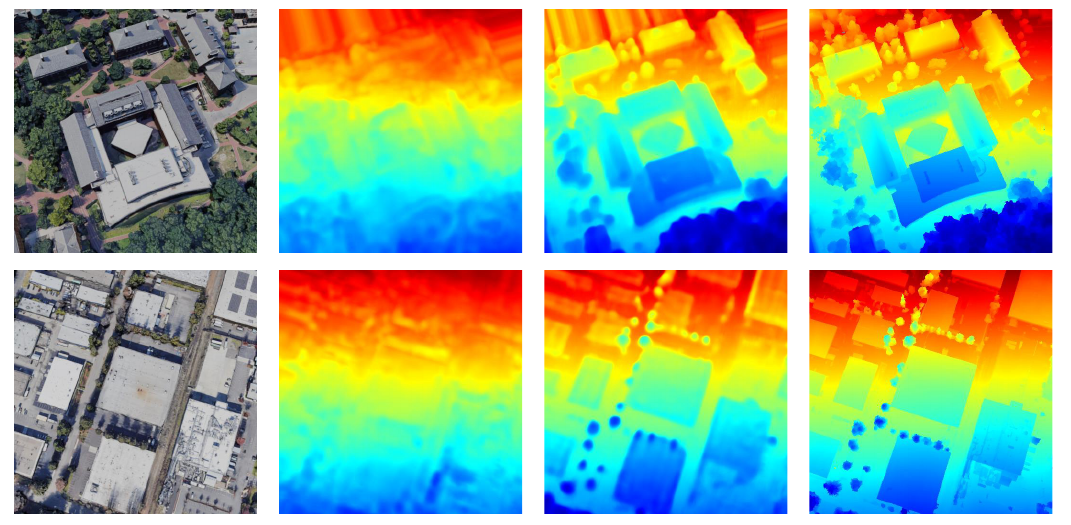
The same planes can render a depth map without training on ground-truth depth. Multiview refinement produces more detailed structure than initialization alone.
Errors remain where depth changes sharply, including object boundaries. The paper’s depth evidence is qualitative; the image-quality results do not establish metric depth or surveying accuracy.
Explore novel-view renderings of three LEVIR-NVS scenes from different perspectives.
Observation · Novel views rendered from the optimized ImMPI.
Church · Novel views rendered from the optimized ImMPI.
Downtown · Novel views rendered from the optimized ImMPI.
From images to a scene
The optimized MPI is warped and composited for each target camera pose. Buildings, trees and ground surfaces shift together as the viewpoint changes.
These are recorded renderings. Playback rate is independent of model rendering throughput.
LEVIR-NVS contains sixteen scenes spanning buildings, urban areas, villages and mountains. The dataset uses 3D scene models captured from Google Earth, with multiview images generated in Blender.
@ARTICLE{9852475,
  author={Wu, Yongchang and Zou, Zhengxia and Shi, Zhenwei},
  journal={IEEE Transactions on Geoscience and Remote Sensing},
  title={Remote Sensing Novel View Synthesis With Implicit Multiplane Representations},
  year={2022},
  volume={60},
  number={},
  pages={1-13},
  doi={10.1109/TGRS.2022.3197409}}
Published in IEEE Transactions on Geoscience and Remote Sensing, vol. 60, pp. 1–13, 2022. DOI: 10.1109/TGRS.2022.3197409